Friday, August 3, 2018

Better Buy: Johnson & Johnson vs. Pfizer

Johnson & Johnson (NYSE:JNJ) and Pfizer (NYSE:PFE) rank as the biggest of big pharma companies in the United States. Both companies trace their roots back to the 19th century. Both generate enormous amounts of cash flow and pay solid dividends.

Over the past 12 months, Pfizer has been the clear winner between these two blue-chip pharma stocks. But which is the better pick for investors now? Here's how J&J and Pfizer compare.

Man facing wall with arrows pointing left and right

Image source: Getty Images.

The case for Johnson & Johnson

Johnson & Johnson's solid Q2 performance highlights several reasons to like the stock. First, the company is diversified into several areas of healthcare. J&J isn't just a big pharma company. It also ranks as a leader in consumer healthcare and medical devices. These two segments combined generate more revenue for J&J than its pharmaceuticals business does.�

Another thing Johnson & Johnson's second-quarter results show is the company's ability to make acquisitions that move the needle. For example, last year's acquisition of Swiss drugmaker Actelion contributed an additional $665 million in revenue in Q2 that J&J wouldn't have had otherwise.

But Johnson & Johnson also claims several blockbuster drugs that continue to enjoy strong momentum. Immunology drugs Stelara and Simponi are big winners for the company and are more than offsetting�declines for Remicade, which faces competition from biosimilars. J&J's Invega neuroscience franchise is also performing well.�The company is exceptionally strong in oncology, with soaring sales for Darzalex, Imbruvica, and Zytiga.�

What about Johnson & Johnson's pipeline? The company claims more than 40 late-stage programs. J&J awaits European approval of Erleada, a promising prostate cancer drug that won FDA approval earlier this year. It expects to submit several more oncology drugs for approval over the next three years, including niraparib�for treating prostate cancer and CAR-T therapy JNJ-4528 for treating multiple myeloma.

J&J's dividend is another big plus for the stock. Its yield currently stands at 2.86%. The company has increased its quarterly dividend for 56 consecutive years.

The case for Pfizer

Pfizer isn't as diversified as J&J and could become even less so as it contemplates the possibility of spinning off its consumer health business. However, there's a lot to like about Pfizer's core pharmaceuticals business.

The drugmaker claims three tremendously successful drugs that should continue to generate growth well into the future. Market research firm EvaluatePharma thinks that Eliquis, which Pfizer co-markets with Bristol-Myers Squibb, will be the No. 5 best-selling drug in the world within a few years. Breast cancer drug Ibrance and immunology drug Xeljanz also enjoy strong sales momentum.

We could soon add more drugs to this list. Pfizer and partner Merck�won FDA approval for Steglatro, Steglujan, and Segluromet in treating type 2 diabetes in December 2017. These drugs could together be another blockbuster franchise for Pfizer.

Pfizer's pipeline also includes over 30 programs in late-stage development or awaiting approval. Three oncology drugs that look especially promising are�dacomitinib, lorlatinib, and talazoparib. Pfizer also hopes to step up its rare-disease game, with tafamidis meglumine awaiting FDA approval as a treatment for transthyretin familial amyloid polyneuropathy and sickle cell disease candidate rivipansel in phase 3 testing.�

You won't find many big pharma dividends better than Pfizer's. Its dividend currently yields 3.66%. Over the past five years, Pfizer has increased its dividend by nearly 42% -- higher than J&J's dividend increases of 36% during the period.

Better buy

Both Johnson & Johnson and Pfizer face some challenges. Without its acquisitions and help from currency fluctuations, J&J's revenue growth has been modest. Pfizer continues to be held back by declining sales for drugs that have lost exclusivity and continued product shortages with its sterile injectables business.

However, I like both of these stocks despite the headwinds they face. Over the long run, my view is that both J&J and Pfizer will deliver solid total returns to investors.

Which is the better pick right now? I think the nod goes to Pfizer -- mainly because of the company's higher dividend yield. My hunch is that both companies will generate earnings growth at similar levels over the next few years. But Pfizer's better dividend should allow the stock to produce greater total returns than J&J will.

It's a close call, though. I don't think long-term investors can go wrong with buying either of these stocks.

Thursday, August 2, 2018

Top 10 High Tech Stocks To Buy Right Now

tags:PME,ECL,I,PGR,MJNA,DLTH,CF,LGND,ATAX,KAMN,

Millennials aren't the defining factor in Bank of America's mobile banking strength, which grew by 11 percent in the second quarter to 25.3 million active users, Chairman and CEO Brian Moynihan told CNBC on Monday.

"Our mobile capabilities and core mobile banking go far beyond the millennials," Moynihan told "Mad Money" host Jim Cramer in an exclusive interview after earnings.

"I got asked a question on the earnings call today, ��Is this millennials?��" the CEO said. "Well, there��s 35 million digital users. There aren��t enough millennials to do that. And so it spreads across all age cohorts, even guys as old as us, Jim."

Bank of America reported fiscal second-quarter earnings before Monday's opening bell. The country's second-largest lender saw profit climb 33 percent to $6.8 billion, trouncing Wall Street estimates of $5.92 billion.

Top 10 High Tech Stocks To Buy Right Now: Pingtan Marine Enterprise Ltd.(PME)

Advisors' Opinion:
  • [By Stephan Byrd]

    Pingtan Marine Enterprise (NASDAQ:PME) CEO Xinrong Zhuo purchased 50,000 shares of Pingtan Marine Enterprise stock in a transaction on Thursday, May 17th. The shares were acquired at an average price of $3.66 per share, with a total value of $183,000.00. The transaction was disclosed in a document filed with the SEC, which can be accessed through this hyperlink.

  • [By Stephan Byrd]

    Pingtan Marine Enterprise Ltd (NASDAQ:PME) CEO Xinrong Zhuo purchased 50,000 shares of the company’s stock in a transaction on Friday, May 25th. The shares were purchased at an average price of $3.33 per share, for a total transaction of $166,500.00. The acquisition was disclosed in a legal filing with the SEC, which is available at the SEC website.

Top 10 High Tech Stocks To Buy Right Now: Ecolab Inc.(ECL)

Advisors' Opinion:
  • [By ]

    3. Ecolab (NYSE: ECL)
    This water, hygiene, and energy services company is being heavily bought by Bill Gates. Mr. Gates has purchased around a million shares across several transactions in the last 30 days. His purchase price was between $134.00 and $137.00 per share.

  • [By Logan Wallace]

    Argus Investors Counsel Inc. bought a new position in Ecolab Inc. (NYSE:ECL) during the 2nd quarter, according to the company in its most recent 13F filing with the Securities & Exchange Commission. The firm bought 1,829 shares of the basic materials company’s stock, valued at approximately $257,000.

  • [By ]

    In the Lightning Round, Cramer was bullish on Goldman Sachs (GS) , Berkshire Hathaway (BRK.B) , Ecolab (ECL) , PTC (PTC) , Arista Networks (ANET) , U.S. Concrete (USCR) and Masco (MAS) .

  • [By ]

    Ecolab (ECL) : "That's a terrific situation that I want you to buy more of if it comes down."

    PTC (PTC) : "Not my cup of tea but I understand it's in the sweet spot of tech."

  • [By Neha Chamaria]

    Using the above method, I believe the following five stocks are some of the best Dividend Aristocrats to consider today.

    Dividend Aristocrat Payout Ratio (Last 12 Months) 5-Year Dividend CAGR*� 10-Year Dividend CAGR* Ecolab�(NYSE:ECL) 30.2% 12.9% 12.3% W.W. Grainger�(NYSE:GWW) 45.7% 10.6% 14.2% Cintas Corporation�(NASDAQ:CTAS) 23.7% 19.8% 13.1% Roper Technologies�(NYSE:ROP) 14.6% 20.4% 18.5% A. O. Smith�(NYSE:AOS) 33.6% 25.5% (2.2%)

    *Compound annual growth rate. Data source: S&P Global Market Intelligence. Table by author.

Top 10 High Tech Stocks To Buy Right Now: Intelsat S.A.(I)

Advisors' Opinion:
  • [By Rich Smith]

    Another day, another 10%-plus move for Intelsat (NYSE:I)�stock.

    It's Thursday, and Intelsat is moving steadily higher in afternoon trading, tipping the scales up 16.1% as of 12:12 p.m. EDT. The question is "why?"

  • [By Stephan Byrd]

    Get a free copy of the Zacks research report on Intelsat (I)

    For more information about research offerings from Zacks Investment Research, visit Zacks.com

  • [By Max Byerly]

    Dorsey Wright & Associates purchased a new position in Intelsat SA (NYSE:I) in the second quarter, according to the company in its most recent 13F filing with the SEC. The institutional investor purchased 735,371 shares of the technology company’s stock, valued at approximately $12,196,000. Intelsat accounts for 1.8% of Dorsey Wright & Associates’ portfolio, making the stock its 10th biggest holding. Dorsey Wright & Associates owned about 0.54% of Intelsat at the end of the most recent reporting period.

Top 10 High Tech Stocks To Buy Right Now: Progressive Corporation (PGR)

Advisors' Opinion:
  • [By Joseph Griffin]

    Trexquant Investment LP bought a new stake in shares of Progressive Co. (NYSE:PGR) during the 1st quarter, according to the company in its most recent 13F filing with the Securities and Exchange Commission. The institutional investor bought 60,054 shares of the insurance provider’s stock, valued at approximately $3,659,000.

  • [By Logan Wallace]

    OppenheimerFunds Inc. lessened its holdings in shares of Progressive Corp (NYSE:PGR) by 0.5% in the first quarter, HoldingsChannel reports. The firm owned 5,359,477 shares of the insurance provider’s stock after selling 24,573 shares during the period. OppenheimerFunds Inc.’s holdings in Progressive were worth $326,553,000 at the end of the most recent quarter.

  • [By Max Byerly]

    Get a free copy of the Zacks research report on Progressive (PGR)

    For more information about research offerings from Zacks Investment Research, visit Zacks.com

  • [By Garrett Baldwin]

    Let's talk the top news in the marijuana industry today… including four stocks that could surge up to 1,000% during this election year.�Here's what you need to know…

    The Top Stock Market Stories for Tuesday Goldman Sachs Group Inc. (NYSE: GS) is leading a busy day of earnings reports on Tuesday. Shares are off 0.4% after the firm despite reporting a 40% year-over-year jump in profits and stronger-than-expected revenue. The firm reported earnings per share (EPS) of $5.98 on top of $9.40 billion in revenue. The Wall Street giant was expected to report EPS of $4.67 on top of $8.71 billion in revenue. The investment bank's first six months of 2018 were its strongest in nine years. The stock slipped after the company announced that president David Solomon will be replacing CEO Lloyd Blankfein when he steps down from his role. Blankfein has been CEO for 12 years. It's fair to say that�Amazon.com Inc. (Nasdaq: AMZN) went to the dogs on Monday. The company has extended its Prime Day promotion through 3 a.m. on Wednesday. The announcement came after the firm suffered significant outages during the start of the event on Monday afternoon. Rather than get access to deals, many customers were met with pictures of dogs, the firm's standard error page. Finally, pay close attention to events on Capitol Hill on Tuesday. The U.S. House Judiciary Committee will question leaders of Alphabet Inc. (Nasdaq: GOOGL), Twitter Inc. (NYSE: TWTR), and Facebook Inc. (Nasdaq: FB) about how they store and filter user content. Last year, the Senate and House of Representatives slammed the companies for their roles in and responses to Russia's interference in the 2016 election. Three Stocks to Watch Today: CSX, NFLX, KKR CSX Corp.�(Nasdaq: CSX) will help lead today's earnings calendar. Wall Street expects that the company will report EPS of $0.86 on top of $2.98 billion in revenue. Shares of Netflix Inc. (Nasdaq: NFLX) slipped after the firm's user-growth estimates and quart

Top 10 High Tech Stocks To Buy Right Now: Medical Marijuana, Inc. (MJNA)

Advisors' Opinion:
  • [By ]

    Cronos was the first cannabis company to trade on NASDAQ, but the first American cannabis company to do it was Medical Marijuana Inc. (MJNA) . Developing legal cannabidiol (CBD) products made from hemp, Medical Marijuana Inc. had a major increase in sales from 2016 to 2017 and has begun looking into an expansion into international markets. Like with Aurora, these expenses have meant that it's not making much of a profit. With encouraging signs and warning signs each abounding, it comes down to whether you think this could be worth the risk.

  • [By Sean Williams]

    If I were to choose two marijuana stocks right off the bat that I'd rather watch from the sidelines and never buy, it'd be medical cannabis company Medical Marijuana Inc. (NASDAQOTH:MJNA) and cannabinoid-based drug developer AXIM Biotechnologies (NASDAQOTH:AXIM). The reason they're listed together is because Medical Marijuana Inc. owns 22.67 million shares of AXIM, which is about 40% of its outstanding share count. Their futures really are tied together.

  • [By Javier Hasse]

    Medical Marijuana Inc (OTC: MJNA) announced Q1 2018 as its largest sales revenue quarter in company history with a year-over-year gross revenue increase of 191 percent. Revenue exceeded $10.5 million. The company also announced its subsidiary Kannaway has partnered with Christian Okoye, former all-time rushing leader for the Kansas City Chiefs, to speak out on why the NFL should consider allowing its players to take cannabidiol (CBD). He’s stopped taking all pain medications and is now only taking CBD.

Top 10 High Tech Stocks To Buy Right Now: Duluth Holdings Inc.(DLTH)

Advisors' Opinion:
  • [By Shane Hupp]

    Get a free copy of the Zacks research report on Duluth (DLTH)

    For more information about research offerings from Zacks Investment Research, visit Zacks.com

  • [By Stephan Byrd]

    Express (NYSE: EXPR) and Duluth (NASDAQ:DLTH) are both small-cap retail/wholesale companies, but which is the superior investment? We will contrast the two companies based on the strength of their dividends, analyst recommendations, earnings, institutional ownership, valuation, profitability and risk.

  • [By Shane Hupp]

    Get a free copy of the Zacks research report on Duluth (DLTH)

    For more information about research offerings from Zacks Investment Research, visit Zacks.com

Top 10 High Tech Stocks To Buy Right Now: CF Industries Holdings, Inc.(CF)

Advisors' Opinion:
  • [By Stephan Byrd]

    CF Industries (NYSE:CF) released its quarterly earnings results on Wednesday. The basic materials company reported $0.63 EPS for the quarter, topping the Zacks’ consensus estimate of $0.42 by $0.21, Briefing.com reports. The company had revenue of $1.30 billion for the quarter, compared to analyst estimates of $1.21 billion. CF Industries had a negative return on equity of 0.11% and a net margin of 10.96%. CF Industries’s revenue was up 15.7% compared to the same quarter last year. During the same quarter last year, the firm posted $0.10 earnings per share.

  • [By Max Byerly]

    Neuburgh Advisers LLC cut its stake in CF Industries (NYSE:CF) by 21.1% in the 1st quarter, according to its most recent filing with the Securities and Exchange Commission. The institutional investor owned 9,200 shares of the basic materials company’s stock after selling 2,464 shares during the quarter. Neuburgh Advisers LLC’s holdings in CF Industries were worth $347,000 at the end of the most recent quarter.

  • [By Chris Lange]

    The stock posting the largest daily percentage loss in the S&P 500 ahead of the close was CF Industries Holdings, Inc. (NYSE: CF) which fell about 3% to $43.04. The stock��s 52-week range is $27.27 to $46.20. Volume was about 2.6 million compared to the daily average volume of 2.6 million.

Top 10 High Tech Stocks To Buy Right Now: Ligand Pharmaceuticals Incorporated(LGND)

Advisors' Opinion:
  • [By Logan Wallace]

    Ligand Pharmaceuticals (NASDAQ:LGND) announced its quarterly earnings results on Tuesday. The biotechnology company reported $1.55 EPS for the quarter, topping analysts’ consensus estimates of $0.57 by $0.98, Bloomberg Earnings reports. The firm had revenue of $56.16 million during the quarter, compared to analysts’ expectations of $43.02 million. Ligand Pharmaceuticals had a net margin of 8.90% and a return on equity of 14.44%. The company’s revenue for the quarter was up 91.9% compared to the same quarter last year. During the same quarter last year, the company earned $0.57 earnings per share. Ligand Pharmaceuticals updated its FY18 guidance to $4.85 EPS.

  • [By Joseph Griffin]

    Get a free copy of the Zacks research report on Ligand Pharmaceuticals (LGND)

    For more information about research offerings from Zacks Investment Research, visit Zacks.com

  • [By Stephan Byrd]

    New York State Common Retirement Fund raised its stake in shares of Ligand Pharmaceuticals Inc. (NASDAQ:LGND) by 30.7% in the 1st quarter, according to the company in its most recent filing with the Securities & Exchange Commission. The fund owned 56,216 shares of the biotechnology company’s stock after purchasing an additional 13,219 shares during the period. New York State Common Retirement Fund owned 0.27% of Ligand Pharmaceuticals worth $9,285,000 at the end of the most recent quarter.

  • [By Todd Campbell, Keith Speights, and Brian Feroldi]

    Investing in biotech stocks can be risky because clinical trial failures can lead to eye-popping drops in share prices. Nevertheless, the potential to benefit from revolutionary new medicines can make owning biotech stocks in a diversified portfolio smart. If you're hunting for new biotech stocks to buy, these three Motley Fool investors think you should consider�Ligand Pharmaceuticals (NASDAQ:LGND), Viking Therapeutics (NASDAQ:VKTX), and Amarin Corporation (NASDAQ:AMRN). Each of these companies has catalysts that could make now a good time to pick up shares.

  • [By Logan Wallace]

    Ligand Pharmaceuticals Inc. (NASDAQ:LGND) has been assigned a consensus rating of “Buy” from the nine analysts that are covering the company, MarketBeat reports. One investment analyst has rated the stock with a sell rating, one has given a hold rating and six have assigned a buy rating to the company. The average 12-month target price among brokerages that have issued a report on the stock in the last year is $159.00.

  • [By Logan Wallace]

    These are some of the news stories that may have effected Accern Sentiment’s scoring:

    Get Ligand Pharmaceuticals alerts: Ligand Pharmaceuticals (LGND) Insider Sells $1,488,722.03 in Stock (americanbankingnews.com) Geron (GERN) Q1 Loss Narrows Y/Y, Revenues Fall, Shares Down (finance.yahoo.com) Ligand Pharmaceuticals (LGND) Upgraded to A- by TheStreet (americanbankingnews.com) Ligand to Participate in Upcoming Investor Conferences (finance.yahoo.com) Ligand Pharmaceuticals Shows Rising Price Performance With Jump To 87 RS Rating (investors.com)

    A number of research firms recently issued reports on LGND. TheStreet raised Ligand Pharmaceuticals from a “c+” rating to an “a-” rating in a research report on Wednesday. HC Wainwright reissued a “buy” rating and set a $170.00 price objective on shares of Ligand Pharmaceuticals in a research report on Friday, February 2nd. Zacks Investment Research raised Ligand Pharmaceuticals from a “hold” rating to a “buy” rating and set a $171.00 price objective for the company in a research report on Wednesday, February 28th. BidaskClub cut Ligand Pharmaceuticals from a “strong-buy” rating to a “buy” rating in a research report on Tuesday, February 27th. Finally, Roth Capital lifted their price objective on Ligand Pharmaceuticals from $158.00 to $171.00 and gave the company a “buy” rating in a research report on Monday, February 26th. One research analyst has rated the stock with a sell rating, six have issued a buy rating and one has issued a strong buy rating to the company’s stock. The stock currently has an average rating of “Buy” and a consensus price target of $161.00.

Top 10 High Tech Stocks To Buy Right Now: America First Tax Exempt Investors L.P.(ATAX)

Advisors' Opinion:
  • [By Shane Hupp]

    Shares of America First Tax Exempt Investors, L.P. (NASDAQ:ATAX) hit a new 52-week high and low during mid-day trading on Monday . The company traded as low as $6.47 and last traded at $6.43, with a volume of 54800 shares changing hands. The stock had previously closed at $6.43.

  • [By Shane Hupp]

    Get a free copy of the Zacks research report on America First Multifamily Investors (ATAX)

    For more information about research offerings from Zacks Investment Research, visit Zacks.com

  • [By Max Byerly]

    Get a free copy of the Zacks research report on America First Multifamily Investors (ATAX)

    For more information about research offerings from Zacks Investment Research, visit Zacks.com

Top 10 High Tech Stocks To Buy Right Now: Kaman Corporation(KAMN)

Advisors' Opinion:
  • [By Shane Hupp]

    Kaman Aircraft (NYSE:KAMN) hit a new 52-week high and low on Wednesday . The stock traded as low as $67.95 and last traded at $68.00, with a volume of 2807 shares traded. The stock had previously closed at $67.07.

Tuesday, July 31, 2018

Diplomat Pharmacy (DPLO) Shares Down 10.4%

Shares of Diplomat Pharmacy Inc (NYSE:DPLO) dropped 10.4% during mid-day trading on Friday . The company traded as low as $22.21 and last traded at $22.33. Approximately 3,371,300 shares traded hands during mid-day trading, an increase of 267% from the average daily volume of 918,233 shares. The stock had previously closed at $24.93.

DPLO has been the subject of a number of recent analyst reports. Zacks Investment Research cut Diplomat Pharmacy from a “hold” rating to a “sell” rating in a research report on Tuesday, May 1st. ValuEngine cut Diplomat Pharmacy from a “buy” rating to a “hold” rating in a research report on Monday, July 2nd. Morgan Stanley raised their price objective on Diplomat Pharmacy from $16.00 to $21.00 and gave the company an “equal weight” rating in a research report on Tuesday, July 3rd. Leerink Swann reaffirmed an “outperform” rating and issued a $33.00 price objective on shares of Diplomat Pharmacy in a research report on Friday, June 22nd. Finally, JPMorgan Chase & Co. raised Diplomat Pharmacy from a “neutral” rating to an “overweight” rating in a research report on Thursday, May 10th. Eight investment analysts have rated the stock with a hold rating and six have given a buy rating to the company. The stock has an average rating of “Hold” and an average target price of $26.64.

Get Diplomat Pharmacy alerts:

The firm has a market capitalization of $1.66 billion, a price-to-earnings ratio of 25.38 and a beta of 1.33. The company has a quick ratio of 0.57, a current ratio of 0.88 and a debt-to-equity ratio of 0.59.

Diplomat Pharmacy (NYSE:DPLO) last released its quarterly earnings results on Monday, May 7th. The company reported $0.20 earnings per share for the quarter, missing the Thomson Reuters’ consensus estimate of $0.21 by ($0.01). The firm had revenue of $1.34 billion for the quarter, compared to analyst estimates of $1.28 billion. Diplomat Pharmacy had a return on equity of 8.80% and a net margin of 0.23%. The business’s revenue for the quarter was up 24.4% on a year-over-year basis. During the same period in the previous year, the business posted $0.19 earnings per share. equities research analysts anticipate that Diplomat Pharmacy Inc will post 0.92 EPS for the current year.

In related news, Director Shawn Tomasello sold 1,680 shares of Diplomat Pharmacy stock in a transaction that occurred on Tuesday, June 5th. The stock was sold at an average price of $24.27, for a total transaction of $40,773.60. Following the completion of the sale, the director now directly owns 12,816 shares of the company’s stock, valued at approximately $311,044.32. The transaction was disclosed in a legal filing with the SEC, which is accessible through the SEC website. Also, Director Jeffrey G. Park sold 1,695 shares of Diplomat Pharmacy stock in a transaction that occurred on Monday, June 11th. The stock was sold at an average price of $25.26, for a total value of $42,815.70. The disclosure for this sale can be found here. Over the last three months, insiders have sold 17,250 shares of company stock valued at $419,364. 24.70% of the stock is currently owned by insiders.

A number of large investors have recently added to or reduced their stakes in the stock. Frontier Capital Management Co. LLC lifted its holdings in Diplomat Pharmacy by 2.5% during the 1st quarter. Frontier Capital Management Co. LLC now owns 3,919,051 shares of the company’s stock worth $78,969,000 after purchasing an additional 94,861 shares during the last quarter. GW&K Investment Management LLC lifted its holdings in Diplomat Pharmacy by 1.9% during the 1st quarter. GW&K Investment Management LLC now owns 1,024,336 shares of the company’s stock worth $20,640,000 after purchasing an additional 19,222 shares during the last quarter. Point72 Asset Management L.P. lifted its holdings in Diplomat Pharmacy by 1,424.3% during the 1st quarter. Point72 Asset Management L.P. now owns 939,562 shares of the company’s stock worth $18,932,000 after purchasing an additional 877,922 shares during the last quarter. Redwood Investments LLC bought a new position in Diplomat Pharmacy during the 1st quarter worth $16,716,000. Finally, Matarin Capital Management LLC bought a new position in Diplomat Pharmacy during the 1st quarter worth $12,790,000. 74.85% of the stock is owned by institutional investors and hedge funds.

Diplomat Pharmacy Company Profile

Diplomat Pharmacy, Inc operates as an independent specialty pharmacy in the United States. The company stocks, dispenses, and distributes prescriptions for various biotechnology and specialty pharmaceutical manufacturers. It also provides specialty infusion pharmacy, patient care coordination, clinical, compliance and persistency program, patient financial assistance, specialty pharmacy training/consulting, benefits investigation, prior authorization, risk evaluation and medication strategy, retail specialty, and hub services, as well as clinical and administrative support services to hospitals and health systems.

See Also: What does RSI mean?

Saturday, July 21, 2018

What You Need to Know About Tesla's Big Downgrade Today

Every day, Wall Street analysts upgrade some stocks, downgrade others, and "initiate coverage" on a few more. But do these analysts even know what they're talking about? Today, we're taking one high-profile Wall Street pick and putting it under the microscope...

Tesla (NASDAQ:TSLA) stock dropped more than 2% in the opening minutes of trading Thursday, and this time, it wasn't CEO Elon Musk's tweets that were to blame -- or at least not directly.

This time, you can thank Needham & Co. for the sell-off. Here's what you need to know.

Tesla Model X and Model S

Tesla sells electric cars -- but is it selling the right electric cars? Image source: Tesla.

Downgrading Tesla

Early this morning, analysts at the New York-based investment banker downgraded Tesla shares from hold to underperform (Wall Street-speak for "sell"). Needham cited several reasons for its newly bearish stance on the electric-car maker, as outlined in a report on StreetInsider.com (subscription required).

Let's address them in order.

Product mix

Tesla has a lot of irons in the fire, but currently just three car models in mass production: the Model S flagship sedan, the Model X SUV, and the Model 3 "mass market" sedan. Of these, Model S and Model X are believed to be the more profitable models. Problem is, Needham believes that "Model S/X" sales are slowing.

Needham ascribes the decreased sales to "increased competition." The analyst also worries that Model 3 sedans may be causing "possible cannibalization" of sales of Tesla's more profitable models.

On top of all that,�the more electric cars Tesla sells, the closer it gets to the point where the U.S. government will no longer subsidize consumer purchases of those cars with $7,500 electric car tax credits -- a factor that could potentially depress sales across the board.

Give 'em some credit -- please!

Speaking of credits, tax credits for consumers are just one side of the Tesla equation. The company also resells to other manufacturers tax credits it gets for the production of zero-emission vehicles; in some years, such sales account for as much as 19% of its gross profit.

Needham predicts that this ZEV revenue will "decline in 2019," constricting the supply of free government money that Tesla has relied upon to support its race to profitability.

Model 3 problems -- and margin is one

Getting back to the Model 3, though, Tesla recently confirmed it had succeeded in building more than 5,000 Model 3 sedans in a single week -- and promised to soon hit a new level of 6,000 per week. Needham, however, warns Tesla may be failing to reap economies of scale from faster production.

"[G]ross margin improvement" on the Model 3, says Needham, could be "slower" than expected due to "persistently high manufacturing costs" as Tesla does everything and anything it can to hit its numbers (paying workers for overtime for example, and building cars in tents), regardless of whether all these efforts are profitable.

Complicating matters further, Needham notes that its "checks" on the market show that Tesla is experiencing net cancellations of Model 3 orders by customers as "refunds are outpacing deposits." The analyst believes this trend is accelerating,�with as many as 24% of would-be buyers now asking for their money back.

The sun also sets

Meanwhile, Tesla continues to be dogged by fallout from its ill-fated acquisition of SolarCity in 2016. Last month, Tesla announced layoffs of as much as 9% of its workforce, with many job cuts falling in the SolarCity segment of the company's business.

While this might be a good business move, aimed at cutting costs and lowering losses from Tesla's solar power business, Needham explains that it's likely to reduce revenue from solar. Since revenue growth is one of the few metrics investors can examine when deciding whether to invest in unprofitable Tesla, a slowdown in revenue growth can't be good news for the stock.

The most important point

In a coup de grace, Needham ends with a point on Tesla's cash burn.

Tesla burned through $4.1 billion in negative free cash flow last year -- twice its $2 billion reported loss and more than twice the $1.6 billion in negative free cash flow it suffered in 2016, according to data from S&P Global Market Intelligence. Faster Model 3 production is supposed to mitigate cash burn, but Needham believes Tesla will still go through a further $6 billion "through 2020."

The analyst also notes that Tesla has a $1.5 billion debt payment coming due in 2019. Although Tesla has enough cash in the bank ($2.7 billion, according to S&P Global figures) to cover that payment now, continued cash burn will eat away at it, meaning that by the time Tesla's debt comes due, it may not have cash on hand to pay it. That implies additional debt issuance (i.e., paying debt with more debt) or stock sales (i.e., dilution) may be necessary to keep Tesla solvent.

None of this adds up to much of a buy thesis for Tesla stock -- but it may justify a sell.

Friday, July 20, 2018

United Continental Stock Soars 9% on Q2 Earnings Beat

United Continental (NYSE:UAL) has been a perennial laggard in the airline industry in recent years, with a pre-tax margin well below that of Delta Air Lines (NYSE:DAL). A few years ago, the company installed a new management team with the goal of closing that margin gap. After some initial struggles, United's turnaround strategy has finally started to gain traction in 2018.

On Tuesday afternoon, the company reported better-than-expected results for the second quarter of 2018, along with solid guidance for the third quarter and full year. This good news sparked a 9% rally for United Continental stock on Wednesday.

Margin pressure continues -- but it could have been worse

Entering the second quarter, United Airlines projected that it would post a 1% to 3% increase in passenger revenue per available seat mile (PRASM). While this was better than what some analysts had projected, it was clearly not going to be enough to offset the full impact of rising fuel costs. United estimated that its adjusted pre-tax margin would slip to a range of 9% to 11%, compared to 13.2% a year earlier.

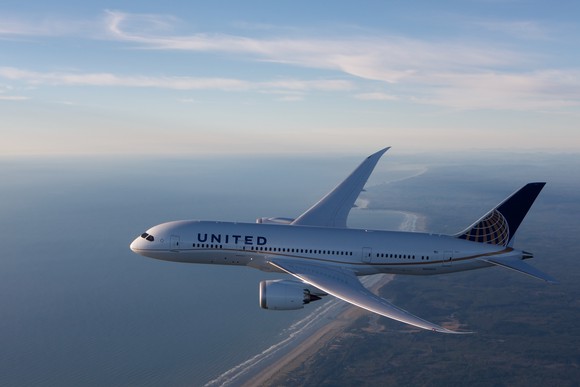
Fuel prices rose even more than initially expected during the second quarter, reaching $2.26 per gallon, up 39% year over year. However, PRASM jumped 3%, reaching the high end of United's forecast range. International markets performed particularly well.

A United Airlines plane flying over a coastline

United Airlines posted solid unit revenue growth last quarter. Image source: United Airlines.

As a result, United Airlines managed to post an adjusted pre-tax margin of 10.4% last quarter (in the upper half of its guidance range). Adjusted earnings per share rose to $3.23 from $2.76 a year earlier, driven by share buybacks and the reduction of the federal corporate tax rate. On average, Wall Street analysts had expected EPS of $3.07.

United's adjusted pre-tax margin fell by 2.8 percentage points last quarter, compared to a 2.9-percentage-point decline at Delta. Considering that United's accelerated capacity growth raised the risk of short-term margin pressure, holding the margin gap with Delta steady was a big accomplishment.

Strong guidance as well

Looking ahead to the third quarter, United Airlines projected that unit revenue growth will accelerate, with PRASM up 4% to 6% year over year. Meanwhile, fuel costs are expected to be up substantially year over year once again, but nonfuel unit costs are on track to decline slightly.

The net result is that United's adjusted pre-tax margin will likely come in between 8% and 10%, down from 10.4% in the year-ago period. If a recent pullback in oil prices continues, there could be upside to that forecast.

Additionally, United Airlines raised its full-year EPS forecast for the second time this year. The original guidance range was $6.50-$8.50. United updated that to $7.00-$8.50 in April and $7.25-$8.75 in conjunction with its Q2 earnings report. The carrier also tweaked its full-year capacity guidance. It now plans to grow 4.5%-5%, down from its prior forecast of 4.5%-5.5% growth.

Delta still looks like a better investment

There wasn't anything to complain about in United's second-quarter earnings report. However, while it is now keeping pace with Delta (on a relative basis), it still isn't clear that it has the wherewithal to close the long-standing margin gap.

Indeed, Delta's adjusted pre-tax margin was nearly 4 percentage points ahead of United's in the first half of 2018. For the third quarter, Delta Air Lines expects to post a 12% to 14% pre-tax margin, once again ahead of United Airlines by about 4 percentage points.

To be fair, United Airlines' market cap is considerably lower, so the two companies trade for similar earnings multiples. However, Delta has less debt, and its higher profit margin makes it a less risky investment and should justify a higher earnings multiple. United Airlines is gradually stabilizing its profitability -- which is certainly a good sign -- but as long as the margin gap remains intact, Delta Air Lines stock is likely to be a better long-term investment.

Thursday, July 19, 2018

Papa John's Wants to Erase Papa From the Company

In this segment from�MarketFoolery, host Mac Greer is joined by analysts Jason Moser and Taylor Muckerman to consider the difficult needle that�Papa John's�(NASDAQ:PZZA)�will have to thread in distancing itself from John Schnatter, the ego-driven, foot-embedded-in-mouth founder. He was pushed to resign as chairman after word got out that he had used a racial slur during a corporate training session.

Now, the company's board has booted him from its corporate offices and is moving to expunge him from its advertising and branding. The question is whether that's feasible. And how far can Papa John's go in this disentanglement when Schnatter still owns 30% of it?

A full transcript follows the video.

This video was recorded on July 16, 2018.

Mac Greer: Let's begin with the ongoing soap opera that is Papa John's. This story is a mess. More fallout from reports that founder John Schnatter used a racial slur, the n-word, in a conversation with the company's former media agency. That happened last week, Jason. Schnatter acknowledged using the slur. He said it was in the context of a training exercise. And, he resigned as chairman.

Now, Papa John's has decided to evict Schnatter from the company's headquarters. They're scrubbing all of their marketing, trying to get rid of him from all of their marketing materials, and they're going to review all the ties that the company has with him. But the company is named Papa John's! What do they do?

Taylor Muckerman: What isn't tied to him?

Jason Moser: Like you said, this is a really tough situation. I think they are ultimately doing the right thing in trying to take action here quickly, as opposed to deliberating what they may or may not want to do. He's already fanned the flames in regard to other issues, whether it was the NFL situation ... he's had a really not good couple of years.

I think this really shines the light on the risks involved with any business where the individual is so closely associated with the brand. I mean, it's in the name, Papa John's. His likeness is on the pizza boxes. I think they're smart to try to get out in front of this thing and erase his existence. I don't know that people were buying the pizza because of him. I think people buy the pizza because they either like it or it's just really easy to do it from the app on your phone.

Greer: And they are getting his face off the boxes.

Moser: This just gives you the opportunity to set this business up for success for many years to come, if you can navigate this de-affiliation.

Greer: Taylor, what do you do here, if you're Papa John's?

Muckerman: I don't know. That's tough. It's certainly going to involve some costs. They'll probably have to retape every single commercial they've had over the last five or ten years. Probably won't be seeing any Papa John's spots during your commercial breaks over the next few months. It seems like they're going full bore. It'll probably be a little costly. They're going to be busy over there in the Papa John's marketing department.

Moser: He owns a good chunk of shares. That doesn't mean he can do whatever he wants to do. Really, that is the benefit of having a board and having leadership that is somewhat separated from executives or founders. You're not just stuck with one person calling all the shots.

Muckerman: Peyton Manning is no longer a quarterback. He sold his stores, but maybe he could come out of retirement and be the new CEO of Papa John's. [laughs]

Moser: What's the over-under on Peyton Manning starting some Pizza Hut franchises now that Pizza Hut is the NFL --

Greer: Do you rename it Peyton Manning's Pizza? Or PJ's?

Moser: [laughs] I think a lot of people would probably still feel like Peyton and John are a little too ...

Greer: Too tight.

Muckerman: They're still friends, yeah.

Moser: There's too much association there.

Greer: This quote really struck me. Papa John's is based in Louisville, Kentucky. A former Papa John's marketing director, a guy named Gary Langstaff, had this to say about Schnatter's problems. He said, "When you have an ego the size of Louisville, you say things without considering the ramifications."

Moser: Certainly.

Greer: I this once again -- I have to trademark this, it's the Mac Greer Humility Index. This guy lacks humility. He has a big mouth. When you throw in the racial insensitivity, then you have a bad, bad combination.

Moser: I kind of like that. Say that again, the Mac Greer ...

Greer: It's the Mac Greer Humility Index. The most humble CEOs I know, like Jim Sinegal -- not that I know a lot of CEOs, but just go with it.

Moser: [laughs] OK, I was waiting until this conversation was going toward Costco.

Greer: It's hypothetical. I just think that humility is a business advantage. It's not just a nice attribute, it's a business advantage.

Moser: I 100% agree, and I like that you're coining phrases with your own name in them.

Muckerman: That's true. Very humble.

Moser: It's a very humble act.

Greer: That's so true. I'm pathetic.

Moser: Last week, I was looking at Costco's June comps, remember? I was showing you, that was what we coined the Mac Greer Effect. It was your bump on Costco's sales --

Greer: OK, let's get my name out of it. I don't want my name in it.

Muckerman: MGHI.

Greer: It's a fair point. Gosh.

Moser: I think you have hit on a very important issue, in all seriousness, because clearly, he lacks the humility needed. I think you see other CEOs out there, they're figuring out ways to tap dance around these types of things, too. Let's use Elon Musk as an example, because recently he got in a skirmish on Twitter and blah blah. That's not the first time he's done that. You look at Elon Musk and Tesla. Now, Elon's likeness is not used for Tesla, and Tesla doesn't have his name in it, but that association is so close that he has to be very careful with stuff like that.

Muckerman: Oh, for sure.

Moser: And whether it was this back and forth with someone in regard to the cave rescue, or it was the political contributions --

Muckerman: The Republican Super PACs, yeah.

Moser: You see people on Twitter now going crazy, like, "I'm canceling my Tesla because I don't want to have this," and it's like, whatever. But, you see the problems when you have a company that's so levered to the individual. The individual has to be able to temper themselves. You have to learn when to just shut your mouth. In today's day and age, it's very easy to be heard anywhere, anytime.

It's easy for us to sit here and say it, I think it's a little bit more difficult in practice. People who are that successful, particularly that quickly, I mean, part of it is the hubris that got them there. Having to figure out how to temper that is, maybe, a little bit more difficult.

Greer: I'm going to take your advice. Now it's just the Humility Index, and I'm not trademarking it. Anyone can use it.

Moser: I'm keeping the Mac Greer Effect for my own purposes.

Greer: No! I want that out! I wish I had never said that! I apologize.

Wednesday, July 11, 2018

Facebook will chip in for users' birthday fundraisers

Facebook is sweetening the pot for all birthday fundraisers posted on its platform.

Continuing its efforts for social good -- and helping to get back into good graces with its users -- the social network said on Tuesday it will donate $5 to every newly created fundraiser posted on a US user's birthday. The fundraiser must support one of the 750,000 vetted US nonprofits approved to raise money using the platform.

Last year, Facebook (FB) introduced the feature, allowing users to select an organization, set a goal amount and enter a custom message. Friends who see the post can make a donation.

The money will come from the Facebook Donations Fund to help nonprofits boost fundraising. The company previously said it would pour $50 million into the fund for 2018.

Facebook will only be adding contributions for a limited time, but Ian Alexander -- a product manager on Facebook's Social Good team -- didn't elaborate on a timeline.

"We're committed to helping as long and as much as we can," Alexander told CNNMoney.

It's unclear how much money has been raised through the effort or how many users have participated. However, Alexander said birthday fundraisers are one of the company's most popular fundraising tools.

In November, the company eliminated fees for nonprofits, so 100% of donations made through the platform go directly to the groups.

Donations like this can add a new stream of revenue for nonprofits without requiring much effort on their part.

The Marine Mammal Center, a California-based nonprofit that rescues marine mammals, said it has raised about $30,000 from Facebook birthday fundraisers over the last year. Overall, the majority of its revenue comes from individual donors.

"For nonprofits across the board, it can cost a lot of money to raise a dollar," said Laura Sherr, a spokeswoman for The Marine Mammal Center. "To have a platform and a channel that does not require a lot of work on our end means we can spread our story to even more people."

Christopher McClean, an analyst at Forrester, applauded Facebook's efforts to give back and engage with users but said it could be seen as an effort to boost the company's image after a tough year so far. The company recently faced concerns over data handling and a bug that temporarily unblocked users.

"[Some people] won't be swayed by this campaign," he said. "They want very clear and specific changes Facebook is making to take care of people's privacy and protect their data."

Monday, July 9, 2018

Driving the Subaru 360, one of the worst cars ever sold in America

Proving that, in America, anything is possible, Subaru got its start here 50 years ago by importing a car so bad it nearly doomed the brand from the start.

Today, Subaru (FUJHF) cars and SUVs are lauded for their safety and quality. Consumer Reports, arguably the most influential magazine among car shoppers, routinely praises its products.

Consumer Reports was influential in 1968, too, which is why the magazine's devastating review of the tiny Subaru 360 was so damaging. It took the tiny car a full 37.5 seconds to go from zero to 50 miles an hour. Sixty miles an hour on flat ground wasn't really possible with the car's 25 horsepower two-cylinder engine. That was probably a good thing. The front bumpers were "virtually useless against anything more formidable than a watermelon," the magazine said. Handling was dangerously bad. During abrupt maneuvers, the back wheels tended to curl up under the car like a turtle's leg.

In short, the Subaru 360 was "Not Acceptable," the magazine wrote, in large letters.

Sales of the 360 collapsed. The man whose idea it had been to import the cars, Malcolm Bricklin, left the company. He would try again, about 20 years later, with a Yugoslav car imported as the Yugo. In a recent interview with CNNMoney, Bricklin blamed Consumer Reports for the 360's failure and insisted the car wasn't bad, considering its price. It cost $1,300. Toyota's cheapest model, the Corolla, cost hundreds more.

Bricklin's clever idea with the 360 was to import a car that wasn't, under American rules, a car at all. As far as American regulators were concerned, if it weighed less than 1,000 pounds, it was not a car and, so, was exempt from many regulations. The Subaru 360 weighed 965 pounds.

My curiosity, and my courage, were piqued. I had never heard of a car this bad. I have driven a Yugo, and it didn't really seem atrocious, considering its $3,995 starting price in the late 1980s, thousands less than a Toyota Tercel.

subaru 360 Small and underpowered in its day, the Subaru 360 feels even more out of place on modern roads.

The 360 I borrowed from a top Subaru USA executive and drove on roads and highways around the company's New Jersey headquarters was, indeed, awful. In fact, it was the very worst car I have ever driven. It made me alternately laugh out loud and fear, deep down in my quivering guts, for my very life.

A Subaru 360 is 3 feet shorter than a Volkswagen Beetle. It is a tiny car on tiny wheels with a tiny little engine. On a modern highway, it is a toy sailboat in a rushing river of mega-yachts. I leaned forward, trying to crush the gas pedal down a little further. The mower-sized two-cylinder engine raged loudly, trying its hardest to keep me from getting run over by SUVs. The best I could manage, ever, was something over 45 miles an hour, and it took everything to get there.

subaru 360 Even by the standards of cheap cars, the Subaru 360 was spartan.
Most of the time, the brakes offered the mere suggestion of stopping. They did work, in their way, when I had to make a real panic stop. A car �� one with brakes �� pulled in front of me and stopped hard. Instinctively, my foot smashed the brake pedal. The 360's snout dropped down toward the asphalt while its hind end rose into the air like a cat getting its butt scratched. I yanked at the steering as the car squirmed side to side, threatening to turn sideways and put its belly into the air. Finally, it came to a shuddering stop before I hit anything.

It was a driving experience as impressive as any I have had. It was impressive how far a company can come from a beginning like that.

Friday, July 6, 2018

Two key levels on the S&P 500 will signal where it heads next

For all the talk of a trade war and an eager-to-hike Fed, markets haven��t moved much this summer. The S&P 500 is now back to where it was in mid-May.

Two key levels could bring about the next big swings on the S&P 500, says one market watcher.

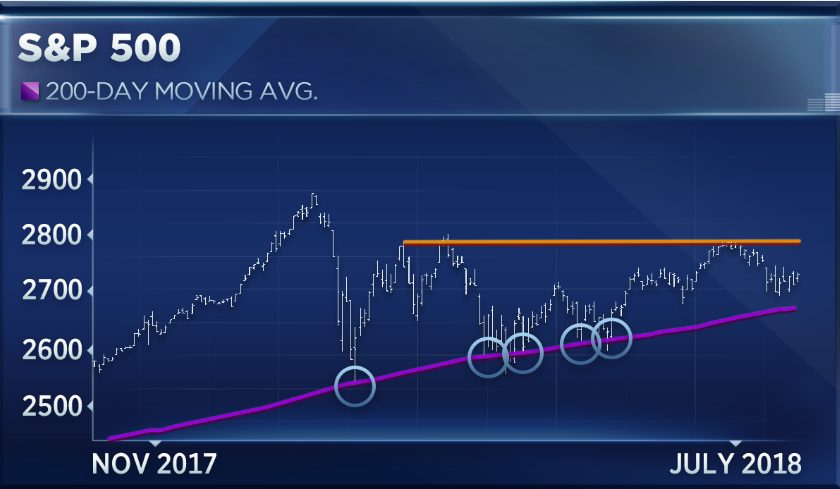
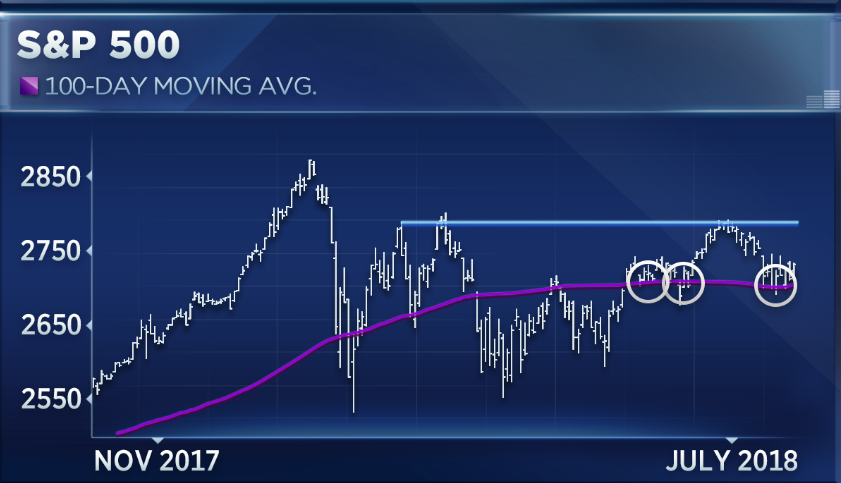
��On the resistance level it��s the 2,800 level. That��s where we topped out in February, March and in June of this year,�� Matt Maley, equity strategist at Miller Tabak, told CNBC��s ��Trading Nation�� on Thursday.

The benchmark index moved as high as a record 2,872 in late January before falling back in early March. It bumped up against 2,800 again in mid-March but failed to hold the level.

��If we can break above that, that��s going to give a lot of upside momentum to the market and we should see a quick move up to the all-time highs. That��s going to be very bullish,�� Maley said.

One level of support lies at its 100-day moving average of 2,705, says Maley. The S&P briefly touched that level in intraday trading in early July, but mostly held above it.

��The more important level, of course, is the 200-day moving average. It is one it��s bounced off of several times this year,�� Maley said. ��You break below that and I think it��s going to be a quick move down to the intraday lows of February.��

The S&P 500 currently trades 2 percent above its 200-day moving average of 2,679. It last broke that trend line in early May.

The risks to the S&P 500 are intensifying, says Boris Schlossberg, managing director of FX strategy at BK Asset Management. He sees the largest headwind in the trade conflict with China.

��The kind of very negative geopolitical implications of a trade war �� could have very long-term ramifications that could basically destroy a lot of this recovery, so I think it��s a touch-and-go situation,�� Schlossberg said on Thursday��s ��Trading Nation.�� ��Until the political situation is kind of resolved and we have some clarity, it��s difficult to make a strong case for equities.��

The U.S. hit China with its first round of tariffs early Friday and has threatened more to come. The Trump administration has imposed tariffs on $34 billion worth of Chinese goods and China immediately retaliated with similar tariffs on U.S. goods.

Vote Vote to see results Total Votes:

Not a Scientific Survey. Results may not total 100% due to rounding.

Disclaimer

Thursday, July 5, 2018

Sainsbury's sales growth slows

(Adds sales numbers from last year and share price)

J Sainsbury PLC (SBRY.LN) said Wednesday that sales growth slowed in the first quarter as it cut prices on key products due to a competitive U.K. grocery market.

Britain's second-largest grocer by market share also said that it has agreed to a 3.50 billion pounds ($4.61 billion) financing package with its existing banks and new institutions for its proposed merger with Asda Group Ltd. Sainsbury's current line of credit will increase to GBP2 billion from GBP1.5 billion, providing further financial flexibility to the combined group.

On April 30, Walmart Inc. WMT, +0.52% said it will sell its U.K. business, Asda, to Sainsbury in a deal worth GBP7.30 billion. If the tie-up is approved by Britain's Competition & Market Authority it would create the largest grocer in the U.K.

For the 16 weeks to June 30, Sainsbury said like-for-like retail sales rose 0.2% compared with 2.3% growth in the same period a year earlier. Total retail sales increased 0.8% verses a 2.7% growth last year.

Grocery sales also slowed with the group recording growth of 0.5% in the first quarter, compared with 3% the previous year and Sainsbury said it has invested GBP150 million to lower prices.

The bright spot in Sainbsury's first quarter was general merchandise, which saw sales rise 1.7% against 1% last year. However, clothing sales grew 0.8%, below the 7.2% growth reported a year earlier.

Sainsbury is losing out to rivals in its core grocery business, according to Neil Wilson, chief market analyst at Markets.com, following data from Kantar Worldwide that said Sainsbury's sales and market share fell in the 12 weeks to June 17, in contrast with its peers. Sainsbury's sales fell 0.2%, while sales for Tesco PLC (TSCO.LN), Asda and Wm. Morrison Supermarkets PLC (MRW.LN) rose between 1.4% and 1.9% in the period. Meanwhile, sales at discount grocers Aldi increased 8.2% and grew 10% at Lidl.

Chief Executive Mike Coupe said general merchandise and clothing, including sales from the Argos catalogue business, "continue to outperform a very challenging market and we are well placed to further grow market share."

Mr Coupe said first-quarter headline numbers reflect price reductions the company made in key areas like fresh meat, fruit and vegetables since March. He said the market remains competitive, but the company has the right strategy in place and the Asda proposed merger will "create a dynamic new player in U.K. retail".

At 1030 GMT, Sainsbury shares were up 6.40 pence, or 2%, at 325 pence.

Wednesday, July 4, 2018

Flotek Industries (FTK) Downgraded to Sell at ValuEngine

ValuEngine lowered shares of Flotek Industries (NYSE:FTK) from a hold rating to a sell rating in a research report sent to investors on Monday morning.
Separately, Zacks Investment Research cut shares of Flotek Industries from a hold rating to a strong sell rating in a research report on Friday, May 11th.

Get Flotek Industries alerts:

Shares of Flotek Industries opened at $3.20 on Monday, Marketbeat reports. The company has a market capitalization of $183.67 million, a PE ratio of -45.71 and a beta of 1.49. Flotek Industries has a 12 month low of $3.03 and a 12 month high of $9.53.

Flotek Industries (NYSE:FTK) last issued its earnings results on Wednesday, May 9th. The oil and gas company reported $0.01 EPS for the quarter, beating the consensus estimate of ($0.10) by $0.11. The company had revenue of $60.52 million during the quarter, compared to analysts’ expectations of $60.50 million. Flotek Industries had a negative net margin of 5.16% and a positive return on equity of 0.37%. The business’s revenue for the quarter was down 24.3% compared to the same quarter last year. During the same period in the previous year, the company earned ($0.01) EPS. sell-side analysts predict that Flotek Industries will post -0.2 earnings per share for the current fiscal year.

In related news, insider H. Richard Walton purchased 20,000 shares of the firm’s stock in a transaction that occurred on Wednesday, May 16th. The shares were bought at an average cost of $3.38 per share, with a total value of $67,600.00. Following the acquisition, the insider now owns 276,547 shares of the company’s stock, valued at approximately $934,728.86. The transaction was disclosed in a legal filing with the Securities & Exchange Commission, which is accessible through this hyperlink. Also, EVP Joshua A. Snively purchased 10,216 shares of the firm’s stock in a transaction that occurred on Wednesday, May 16th. The shares were bought at an average cost of $3.41 per share, for a total transaction of $34,836.56. Following the completion of the acquisition, the executive vice president now directly owns 94,975 shares in the company, valued at approximately $323,864.75. The disclosure for this purchase can be found here. Insiders bought a total of 63,816 shares of company stock valued at $217,013 over the last 90 days. Corporate insiders own 4.86% of the company’s stock.

Several institutional investors have recently made changes to their positions in the stock. Rhumbline Advisers grew its holdings in shares of Flotek Industries by 14.7% during the 4th quarter. Rhumbline Advisers now owns 134,176 shares of the oil and gas company’s stock valued at $625,000 after purchasing an additional 17,161 shares during the last quarter. Boston Partners grew its holdings in shares of Flotek Industries by 2.8% during the 1st quarter. Boston Partners now owns 821,680 shares of the oil and gas company’s stock valued at $5,012,000 after purchasing an additional 22,760 shares during the last quarter. Schwab Charles Investment Management Inc. grew its holdings in shares of Flotek Industries by 10.8% during the 1st quarter. Schwab Charles Investment Management Inc. now owns 282,218 shares of the oil and gas company’s stock valued at $1,722,000 after purchasing an additional 27,597 shares during the last quarter. MetLife Investment Advisors LLC bought a new stake in shares of Flotek Industries during the 4th quarter valued at approximately $133,000. Finally, Trexquant Investment LP grew its holdings in shares of Flotek Industries by 261.4% during the 1st quarter. Trexquant Investment LP now owns 61,177 shares of the oil and gas company’s stock valued at $373,000 after purchasing an additional 44,247 shares during the last quarter. 81.04% of the stock is currently owned by institutional investors.

About Flotek Industries

Flotek Industries, Inc develops and supplies chemistry and services to the oil and gas industries in the United States and internationally. It operates through two segments, Energy Chemistry Technologies; and Consumer and Industrial Chemistry Technologies. The Energy Chemistry Technologies segment is involved in the design, development, manufacture, packaging, and marketing of chemistries under the Complex nano-Fluid brand name for use in oil and gas well drilling, cementing, completion, stimulation, and production activities, as well as for use in enhanced and improved oil recovery markets.

To view ValuEngine’s full report, visit ValuEngine’s official website.

Sunday, June 24, 2018

Live Long and Prosper in These 10 US Counties

The median lifespan in the United States today is nearly 79 years. Like all medians and averages, your mileage may vary. In some U.S. towns and cities, the median falls to around 68, and in others, it rises to more than 85.

What’s different? It’s not just the air or the scenery. According to a report from Realtor.com, the road to a longer lifespan is not the same everywhere, but there are commonalities such as veggie-rich diets and plenty of exercise.

Dan Buettner, founder of a movement called Blue Zones that helps communities set policies to help residents live longer, comments, “If you want to live a long time, the best thing you can do is move to a place where people are verifiably living the longest.”

To come up with their list of U.S. counties where residents live the longest, researchers looked at death certificates in every U.S. country for 2014 to calculate life expectancy from birth. In the following longevity list, they’ve added population data for a notable city in the county and the median home listing price.

Summit County, Colorado
Median lifespan: 86.8 years
City: Breckinridge
Population: 30,585
Median home listing price: $930,500 Billings County, North Dakota
Median lifespan: 84 years
City: Medora
Population: 940
Median home listing price: $331,200 Marin County, California
Median lifespan: 83.8 years
City: San Rafael
Population: 260,651
Median home listing price: $1.43 million Fairfax County, Virginia
Median lifespan: 83.7 years
City: Herndon
Population: 1.15 million
Median home listing price: $608,700 Aleutians East Borough, Alaska
Median lifespan: 83.7 years
City: King Cove
Population: 3,370
Median home listing price: $226,500 Presidio County, Texas
Median lifespan: 83.7 years
City: Marfa
Population: 7,156
Median home listing price: $297,000 San Juan County, Washington
Median lifespan: 83.7 years
City: Friday Harbor
Population: 16,715
Median home listing price: $774,400 Los Alamos County, New Mexico
Median lifespan: 83.5 years
City: Los Alamos
Population: 18,738
Median home listing price: $384,400 Teton County, Wyoming
Median lifespan: 83.5 years
City: Jackson
Population: 23,265
Median home listing price: $1.3 million Collier County, Florida
Median lifespan: 83.4 years
City: Naples
Population: 372,880
Median home listing price: $479,400

More details and information are available at the Realtor.com website.

ALSO READ: The Most Popular Exercise Fad the Year You Were Born


Wednesday, June 20, 2018

Brokerages Expect Axalta Coating Systems Ltd (AXTA) to Announce $0.36 Earnings Per Share

Wall Street brokerages predict that Axalta Coating Systems Ltd (NYSE:AXTA) will post earnings of $0.36 per share for the current fiscal quarter, according to Zacks Investment Research. Four analysts have provided estimates for Axalta Coating Systems’ earnings, with the highest EPS estimate coming in at $0.39 and the lowest estimate coming in at $0.31. Axalta Coating Systems posted earnings of $0.31 per share during the same quarter last year, which would suggest a positive year over year growth rate of 16.1%. The firm is scheduled to issue its next earnings results on Thursday, August 2nd.

On average, analysts expect that Axalta Coating Systems will report full-year earnings of $1.31 per share for the current financial year, with EPS estimates ranging from $1.20 to $1.40. For the next financial year, analysts expect that the firm will post earnings of $1.50 per share, with EPS estimates ranging from $1.33 to $1.65. Zacks Investment Research’s EPS averages are a mean average based on a survey of sell-side research analysts that cover Axalta Coating Systems.

Get Axalta Coating Systems alerts:

Axalta Coating Systems (NYSE:AXTA) last announced its quarterly earnings data on Wednesday, April 25th. The specialty chemicals company reported $0.27 earnings per share (EPS) for the quarter, beating the consensus estimate of $0.23 by $0.04. Axalta Coating Systems had a net margin of 0.94% and a return on equity of 20.56%. The company had revenue of $1.17 billion during the quarter, compared to analysts’ expectations of $1.14 billion. During the same quarter in the prior year, the company earned $0.26 EPS. Axalta Coating Systems’s revenue was up 15.7% compared to the same quarter last year.

Several analysts recently issued reports on AXTA shares. BMO Capital Markets started coverage on shares of Axalta Coating Systems in a research note on Tuesday, March 27th. They set a “market perform” rating and a $33.00 price objective for the company. Zacks Investment Research raised shares of Axalta Coating Systems from a “sell” rating to a “hold” rating in a research note on Wednesday, April 4th. Seaport Global Securities cut shares of Axalta Coating Systems from a “buy” rating to a “neutral” rating in a research note on Tuesday, April 17th. JPMorgan Chase & Co. increased their price target on shares of Axalta Coating Systems from $32.00 to $33.00 and gave the company an “overweight” rating in a research note on Thursday, April 26th. Finally, Bank of America raised shares of Axalta Coating Systems from an “underperform” rating to a “neutral” rating and set a $35.00 price target for the company in a research note on Friday, April 27th. One research analyst has rated the stock with a sell rating, thirteen have issued a hold rating and five have given a buy rating to the company’s stock. The company presently has an average rating of “Hold” and a consensus price target of $34.13.

Shares of Axalta Coating Systems opened at $30.51 on Friday, according to MarketBeat Ratings. Axalta Coating Systems has a 12-month low of $27.77 and a 12-month high of $38.20. The stock has a market cap of $7.48 billion, a P/E ratio of 25.64, a price-to-earnings-growth ratio of 1.63 and a beta of 1.31. The company has a debt-to-equity ratio of 2.57, a current ratio of 2.26 and a quick ratio of 1.63.

In other news, VP Sean M. Lannon sold 3,892 shares of the company’s stock in a transaction that occurred on Tuesday, May 15th. The shares were sold at an average price of $31.12, for a total value of $121,119.04. Following the transaction, the vice president now directly owns 25,273 shares in the company, valued at approximately $786,495.76. The sale was disclosed in a document filed with the SEC, which is accessible through this hyperlink. Also, EVP Steven R. Markevich sold 88,479 shares of the company’s stock in a transaction that occurred on Monday, May 14th. The stock was sold at an average price of $31.32, for a total transaction of $2,771,162.28. Following the completion of the transaction, the executive vice president now owns 323,875 shares in the company, valued at $10,143,765. The disclosure for this sale can be found here. In the last three months, insiders sold 604,588 shares of company stock valued at $18,910,751. Corporate insiders own 2.10% of the company’s stock.

Hedge funds have recently modified their holdings of the company. Quantitative Systematic Strategies LLC acquired a new position in shares of Axalta Coating Systems in the 1st quarter worth approximately $288,000. Advisory Services Network LLC lifted its holdings in shares of Axalta Coating Systems by 5,102.0% in the 4th quarter. Advisory Services Network LLC now owns 22,941 shares of the specialty chemicals company’s stock worth $742,000 after acquiring an additional 22,500 shares during the last quarter. Harvest Management LLC acquired a new stake in Axalta Coating Systems during the 4th quarter worth approximately $955,000. Bronson Point Management LLC acquired a new stake in Axalta Coating Systems during the 4th quarter worth approximately $4,854,000. Finally, California Public Employees Retirement System lifted its holdings in Axalta Coating Systems by 10.8% during the 4th quarter. California Public Employees Retirement System now owns 380,954 shares of the specialty chemicals company’s stock worth $12,328,000 after buying an additional 37,019 shares in the last quarter. Hedge funds and other institutional investors own 98.11% of the company’s stock.

About Axalta Coating Systems

Axalta Coating Systems Ltd., through its subsidiaries, manufactures, markets, and distributes high performance coatings primarily for the transportation industry. It operates in two segments, Performance Coatings and Transportation Coatings. The Performance Coatings segment offers various specially-formulated water and solvent borne products and systems that are used to refinish damaged vehicles for independent body shops, multi-shop operators, and original equipment manufacturer (OEM) dealership body shops.

Get a free copy of the Zacks research report on Axalta Coating Systems (AXTA)

For more information about research offerings from Zacks Investment Research, visit Zacks.com

Earnings History and Estimates for Axalta Coating Systems (NYSE:AXTA)

Tuesday, June 19, 2018

Finisar (FNSR) Getting Somewhat Positive Press Coverage, Analysis Finds

News coverage about Finisar (NASDAQ:FNSR) has been trending somewhat positive on Tuesday, Accern Sentiment Analysis reports. Accern identifies positive and negative press coverage by analyzing more than 20 million blog and news sources. Accern ranks coverage of publicly-traded companies on a scale of -1 to 1, with scores closest to one being the most favorable. Finisar earned a media sentiment score of 0.09 on Accern’s scale. Accern also assigned media stories about the technology company an impact score of 48.3712393394037 out of 100, meaning that recent press coverage is somewhat unlikely to have an effect on the company’s share price in the next few days.

Here are some of the media stories that may have effected Accern Sentiment’s rankings:

Get Finisar alerts: Free Research Report as EchoStar��s Revenues Jumped 16% (finance.yahoo.com) Riding The Finisar Waves (seekingalpha.com) Finisar Announces Fiscal 2018 Financial Results (finance.yahoo.com) Finisar Jumps Despite Weaker Than Expected Q4 Results (nasdaq.com) Finisar Stock Runs Into Familiar Resistance After Earnings (schaeffersresearch.com)

A number of research analysts have issued reports on the company. DA Davidson boosted their price target on Finisar to $26.00 and gave the stock a “buy” rating in a research report on Friday. Needham & Company LLC lowered Finisar from a “buy” rating to a “hold” rating and boosted their price target for the stock from $16.64 to $29.41 in a research report on Friday, March 9th. Morgan Stanley assumed coverage on Finisar in a research report on Friday, March 9th. They set an “equal weight” rating and a $21.00 price target for the company. B. Riley reiterated a “buy” rating and set a $17.50 price target (down previously from $18.00) on shares of Finisar in a research report on Friday, March 9th. Finally, Zacks Investment Research upgraded Finisar from a “sell” rating to a “hold” rating in a research report on Wednesday, May 9th. One investment analyst has rated the stock with a sell rating, seven have assigned a hold rating and eleven have given a buy rating to the company’s stock. The company currently has a consensus rating of “Buy” and a consensus target price of $24.83.

Shares of Finisar opened at $18.25 on Tuesday, MarketBeat reports. Finisar has a 12-month low of $14.25 and a 12-month high of $28.84. The company has a current ratio of 4.00, a quick ratio of 3.24 and a debt-to-equity ratio of 0.30. The firm has a market cap of $2.06 billion, a PE ratio of 57.03, a P/E/G ratio of 2.07 and a beta of 1.19.

Finisar (NASDAQ:FNSR) last posted its quarterly earnings data on Thursday, June 14th. The technology company reported $0.05 earnings per share (EPS) for the quarter, missing analysts’ consensus estimates of $0.12 by ($0.07). Finisar had a positive return on equity of 2.74% and a negative net margin of 3.67%. The company had revenue of $310.07 million for the quarter, compared to the consensus estimate of $309.93 million. During the same period in the prior year, the firm posted $0.50 earnings per share. The business’s revenue was down 13.3% on a year-over-year basis. equities research analysts predict that Finisar will post 0.62 EPS for the current fiscal year.

In other news, Director Roger C. Ferguson sold 3,000 shares of Finisar stock in a transaction on Thursday, March 22nd. The shares were sold at an average price of $17.30, for a total transaction of $51,900.00. Following the completion of the sale, the director now directly owns 28,784 shares of the company’s stock, valued at approximately $497,963.20. The transaction was disclosed in a legal filing with the Securities & Exchange Commission, which is accessible through this hyperlink. Also, Director Jerry S. Rawls sold 38,250 shares of Finisar stock in a transaction on Friday, June 1st. The stock was sold at an average price of $16.67, for a total transaction of $637,627.50. Following the sale, the director now directly owns 601,508 shares of the company’s stock, valued at $10,027,138.36. The disclosure for this sale can be found here. Insiders have sold a total of 109,458 shares of company stock valued at $1,728,950 over the last ninety days. 1.02% of the stock is currently owned by insiders.

Finisar Company Profile

Finisar Corporation provides optical subsystems and components for data communication and telecommunication applications in the United States, China, Malaysia, and internationally. The company's optical subsystems primarily include transmitters, receivers, transceivers, transponders, and active optical cables, which provide the fundamental optical-electrical, or optoelectronic interface for interconnecting the electronic equipment used in networks comprising switches, routers, and servers used in wireline networks, as well as antennas and base stations used in wireless networks.

Insider Buying and Selling by Quarter for Finisar (NASDAQ:FNSR)

Saturday, June 16, 2018

AngloGold Ashanti (AU) Sets New 1-Year Low at $7.90

Shares of AngloGold Ashanti Limited (NYSE:AU) hit a new 52-week low during trading on Friday . The company traded as low as $7.90 and last traded at $8.15, with a volume of 45855965 shares. The stock had previously closed at $8.68.

A number of analysts have recently commented on AU shares. Zacks Investment Research downgraded AngloGold Ashanti from a “buy” rating to a “hold” rating in a research note on Thursday, February 15th. ValuEngine upgraded AngloGold Ashanti from a “sell” rating to a “hold” rating in a research note on Thursday, March 1st. Two analysts have rated the stock with a sell rating, one has assigned a hold rating and four have assigned a buy rating to the company. The company has an average rating of “Hold” and an average price target of $10.75.

Get AngloGold Ashanti alerts:

The company has a quick ratio of 0.63, a current ratio of 1.57 and a debt-to-equity ratio of 0.82. The company has a market capitalization of $3.54 billion, a P/E ratio of 135.83 and a beta of -0.88.

Institutional investors and hedge funds have recently modified their holdings of the company. Two Sigma Advisers LP boosted its stake in shares of AngloGold Ashanti by 41.4% in the fourth quarter. Two Sigma Advisers LP now owns 312,700 shares of the mining company’s stock worth $3,186,000 after buying an additional 91,600 shares during the last quarter. CoreCommodity Management LLC purchased a new position in AngloGold Ashanti during the fourth quarter worth approximately $665,000. Two Sigma Investments LP boosted its position in AngloGold Ashanti by 2,351.4% during the fourth quarter. Two Sigma Investments LP now owns 666,023 shares of the mining company’s stock worth $6,787,000 after purchasing an additional 638,854 shares in the last quarter. Alps Advisors Inc. boosted its position in AngloGold Ashanti by 33.6% during the first quarter. Alps Advisors Inc. now owns 535,456 shares of the mining company’s stock worth $5,081,000 after purchasing an additional 134,668 shares in the last quarter. Finally, Amundi Pioneer Asset Management Inc. purchased a new position in AngloGold Ashanti during the fourth quarter worth approximately $14,112,000. Hedge funds and other institutional investors own 32.93% of the company’s stock.

AngloGold Ashanti Company Profile

AngloGold Ashanti Limited operates as a gold mining company. The company also produces silver, uranium oxide, and sulphuric acid. Its portfolio includes 17 operations and 3 projects in 10 countries in South Africa, Continental Africa, the Americas, and Australasia. AngloGold Ashanti Limited was founded in 1944 and is headquartered in Johannesburg, South Africa.

Friday, June 8, 2018

Here's Why Acorda Therapeutics Rose as Much as 30.3% Today

What happened

Shares of Acorda Therapeutics (NASDAQ:ACOR) rose over 30% today after the company's lawyers made oral arguments in front of a panel at the U.S. Court of Appeals for the Federal Circuit late Thursday. The appeal was made in response to an earlier decision by a U.S. District Court to invalidate four of the company's patents for its multiple sclerosis drug Ampyra, which is the top revenue generator for the business and is expected to deliver at least $330 million in sales in 2018. That's down from $493 million in 2016.��

The timing is important. Acorda Therapeutics has one remaining patent on Ampyra, but it expires in July. That means the Federal Circuit decision on the appeal could be the difference between generic versions of the drug hitting the market this summer or sometime much later, perhaps as late as 2027.

As of 11:49 a.m. EDT, the stock had settled to a 22% gain.

A businessman drawing a yellow step chart heading higher.

Image source: Getty Images.

So what

The company didn't issue a press release or SEC filing because a decision on the appeal is still pending, but the higher-than-usual trading volume today indicates bullishness by an institutional investor or two about what was said during the arguments. Investors can listen to audio of the oral arguments in Acorda Therapeutics Inc. v. Roxane Laboratories Inc. that were made in front of the panel yesterday, although it may be difficult to draw conclusions one way or the other.

According to FiercePharma,�Acorda CEO Ron Cohen tried to quell angst among the company's sales representatives by stating that even if Ampyra loses intellectual property protections, the plan is to transfer everyone to accounts selling Parkinson's disease drug Inbrija. That's either a bullish comment on the drug's prospects, since it's currently awaiting a decision on marketing approval from the Food and Drug Administration, or exactly what investors would expect the CEO to say.

Now what

There's some degree of uncertainty surrounding Acorda Therapeutics right now. The month of June promises to be a volatile one for investors, considering that the Federal Circuit will soon decide whether or not to grant the company's appeal (and restore the invalidated Ampyra patents) and that the only currently valid patent expires in July. Today's move may be a bit premature, however, so investors should probably remain on the sidelines until more certainty is provided.

Wednesday, May 30, 2018

Mid-Day Market Update: Dow Falls Over 400 Points; T2 Biosystems Shares Plunge

Midway through trading Tuesday, the Dow traded down 1.67 percent to 24,340.59 while the NASDAQ declined 0.73 percent to 7,379.71. The S&P also fell, dropping 1.3 percent to 2,685.96.

Leading and Lagging Sectors

On Tuesday, the utilities shares surged 0.69 percent. Meanwhile, top gainers in the sector included Just Energy Group Inc. (NYSE: JE), up 4 percent, and Genie Energy Ltd. (NYSE: GNE) up 3 percent.

In trading on Tuesday, financial shares fell 3 percent.

Top Headline

Booz Allen Hamilton Holding Corporation (NYSE: BAH) reported better-than-expected earnings for its fourth quarter.

Booz Allen posted adjusted earnings of $0.52 per share on revenue of $1.64 billion. However, analysts were expecting earnings of $0.46 per share on revenue of $1.67 billion.

Booz Allen Hamilton expects FY19 adjusted earnings of $2.35 to $2.50 per share on sales growth of 6 percent to 8 percent.


Equities Trading UP

Mammoth Energy Services, Inc. (NASDAQ: TUSK) shares shot up 19 percent to $37.06. Mammoth Energy’s subsidiary Cobra signed a new $900 million contract to finish the restoration of critical electrical services and support the initial phase of reconstruction of the electrical utility system in Puerto Rico.

Shares of American Woodmark Corporation (NASDAQ: AMWD) got a boost, shooting up 14 percent to $100.85 after the company reported upbeat Q4 results.

Axovant Sciences Ltd. (NASDAQ: AXON) shares were also up, gaining 24 percent to $1.49. Axovant announced strengthening of management team and completion of organization restructuring which "enhanced capabilities in research and business development" and reduced internal headcount by 43 percent.

Equities Trading DOWN

Roadrunner Transportation Systems, Inc. (NYSE: RRTS) shares dropped 16 percent to $1.85. Office Depot, Inc. (NASDAQ: ODP) will replace Roadrunner Transportation Systems in the S&P SmallCap 600 on Monday, June 4.

Shares of T2 Biosystems, Inc. (NASDAQ: TTOO) were down 12 percent to $7.80 after the health care company that targets unmet needs received clearance from the FDA. The company said the FDA granted a market clearance for its T2Bacteria Panel for the direct detection of bacterial species in human whole blood specimens from patients with suspected bloodstream infections.

Akers Biosciences, Inc. (NASDAQ: AKER) was down, falling around 30 percent to $0.41 after the company withdrew marketing application for PIFA Chlamydia test device upon recommendation from the FDA.

Commodities

In commodity news, oil traded down 2 percent to $66.52 while gold traded down 0.07 percent to $1,308.10.

Silver traded down 0.67 percent Tuesday to $16.435, while copper fell 0.11 to $3.074.

Eurozone

European shares were lower today. The eurozone’s STOXX 600 tumbled 1.38 percent, the Spanish Ibex Index fell 2.58 percent, while Italy’s FTSE MIB Index declined 2.65 percent. Meanwhile the German DAX dipped 1.53 percent, and the French CAC 40 slipped 1.29 percent while U.K. shares fell 1.26 percent.

Economics

The S&P CoreLogic Case-Shiller home price index increased 6.8 percent year-over-year for March.

The Conference Board’s consumer confidence index climbed to 128 in May, versus a revised reading of 125.6 in April.

The Dallas Fed manufacturing business index rose to 26.80 for May, versus prior reading of 21.80. Economists expected a reading of 23.30.

The Treasury will auction 4-week bills at 1:00 p.m. ET.

Monday, May 28, 2018

Top 5 Energy Stocks To Watch For 2018

tags:P,PES,CRC,PBR,MMP,

Jiangnan Group (OTC:OTC:JNGHF) is one of the largest manufacturers in China of electricity wires and cables. At first, this seems like a very boring commodity industry that seems heavily exposed to a potential bubble. But taking a closer look reveals an industry with very attractive economics (if you are a large player) where peers tend to get high earnings multiples. And that tends towards consolidation. It is also an industry with huge tailwinds in the form of an underserved electricity market in China and massive announced grid infrastructure projects by the Chinese government for hundreds of billions of dollars. And on top of that is very exposed to the build out of green energy and electric cars which will require a lot of (specialized) power cables and wires. And you get to buy all of that at 5x forward earnings (if copper prices stay where they are now) with no net debt. Of course, if you think China will crash and burn, you can probably stop reading here. If not, then read on!

Top 5 Energy Stocks To Watch For 2018: Euro FX(P)

Advisors' Opinion:
  • [By Paul Ausick]

    Pandora Media Inc. (NYSE: P) dropped about 2.2% Friday to post a new 52-week low of $4.39 after closing at $4.49 on Thursday. The stock’s 52-week high is $13.72. Volume was about 6.1 million, about 40% below the daily average of around 11 million. The music streaming company had no specific news.

  • [By Chris Lange]

    Pandora Media Inc. (NYSE: P) and Roku Inc. (NASDAQ: ROKU) are scheduled to report their most recent financial results after the markets close on Wednesday. Pandora has been around for a while and investors can gauge where this stock is headed. However, Roku is reporting its second quarter ever as a public company and this may be tougher to call.

  • [By Joseph Griffin]

    Pandora Media Inc. (NYSE:P) insider Kristen Robinson sold 43,411 shares of Pandora Media stock in a transaction that occurred on Thursday, May 17th. The stock was sold at an average price of $7.44, for a total value of $322,977.84. Following the completion of the transaction, the insider now directly owns 742,416 shares in the company, valued at $5,523,575.04. The sale was disclosed in a legal filing with the SEC, which can be accessed through the SEC website.

  • [By Benzinga News Desk]

    Six months after its debut, Pandora Media Inc (NYSE: P)’s Premium Access has recorded more than 6.5 million listeners and more than 55 million total sessions, a company spokesperson told Benzinga: Link

  • [By Chris Lange]

    Pandora Media, Inc. (NYSE: P) released its most recent quarterly results after markets closed Wednesday. The company said that it had a net loss of $0.21 per share on $395.3 million in revenue, compared with consensus estimates from Thomson Reuters that called for a net loss of $0.07 per share on $376.43 million in revenue. The fourth quarter from last year had a net loss of $0.13 per share and $392.6 million in revenue.

  • [By Steve Symington]

    Shares of Pandora Media Inc. (NYSE:P) jumped 21.2% on Friday after the music-streaming specialist announced better-than-expected first-quarter 2018 results.

Top 5 Energy Stocks To Watch For 2018: Pioneer Energy Services Corp.(PES)

Advisors' Opinion:
  • [By Jason Hall]

    Shares of a handful of small independent oil and gas producers, as well as a number of smaller oilfield service and equipment providers fell more than 10% on May 25.�Profire Energy, Inc.�(NASDAQ:PFIE), which manufactures burner management systems for oil and gas companies, fell 14.5%, while offshore energy industry transportation specialist�Bristow Group Inc�(NYSE:BRS) fell 12.6%. Onshore drilling contractor�Pioneer Energy Services Corp�(NYSE:PES) and offshore oil and gas producer�W&T Offshore, Inc.�both�fell 11.4%, while independent oil and gas producers�California Resources Corp (NYSE:CRC) and�Ultra Petroleum Corp�(NASDAQ:UPL) fell 10.5% and 10%, respectively.�

  • [By Max Byerly]

    Baytex Energy (NYSE: BTE) and Pioneer Energy Services (NYSE:PES) are both small-cap oils/energy companies, but which is the better stock? We will compare the two businesses based on the strength of their institutional ownership, analyst recommendations, profitability, earnings, valuation, risk and dividends.

  • [By Stephan Byrd]

    TIAA CREF Investment Management LLC decreased its holdings in shares of Pioneer Energy Services (NYSE:PES) by 34.9% in the 4th quarter, according to the company in its most recent filing with the Securities and Exchange Commission. The institutional investor owned 174,740 shares of the oil and gas company’s stock after selling 93,636 shares during the period. TIAA CREF Investment Management LLC owned approximately 0.22% of Pioneer Energy Services worth $533,000 as of its most recent filing with the Securities and Exchange Commission.

Top 5 Energy Stocks To Watch For 2018: California Resources Corporation(CRC)

Advisors' Opinion:
  • [By Lisa Levin] Gainers Biostar Pharmaceuticals, Inc. (NASDAQ: BSPM) shares jumped 29.86 percent to close at $2.87 on Friday. Commercial Vehicle Group, Inc. (NASDAQ: CVGI) shares gained 28.87 percent to close at $8.75 after reporting upbeat Q1 earnings. Mexco Energy Corporation (NYSE: MXC) gained 27.02 percent to close at $5.4744. Carbon Black, Inc. (NASDAQ: CBLK) climbed 26 percent to close at $23.94. Carbon Black priced its IPO at $19 per share. Portola Pharmaceuticals, Inc. (NASDAQ: PTLA) rose 25.64 percent to close at $42.44 after the FDA approved the company's Andexxa, the only antidote indicated for patients treated with rivaroxaban and apixaban. Natural Grocers by Vitamin Cottage, Inc. (NYSE: NGVC) rose 23.19 percent to close at $8.50 after reporting Q2 results. California Resources Corporation (NYSE: CRC) shares gained 22.45 percent to close at $31.58 following upbeat Q1 earnings. Atomera Incorporated (NASDAQ: ATOM) gained 22.31 percent to close at $6.25 after reporting Q1 results. Medifast, Inc. (NYSE: MED) shares jumped 22.27 percent to close at $121.46 after the company reported strong Q1 results and raised its FY18 guidance. Jerash Holdings (US), Inc. (NASDAQ: JRSH) gained 20.86 percent to close at $8.46. Pandora Media, Inc. (NYSE: P) rose 19.83 percent to close at $6.89 after reporting strong quarterly results. Shake Shack Inc (NYSE: SHAK) rose 18.01 percent to close at $55.95 on Friday after the company reported upbeat results for its first quarter and raised its FY18 guidance. Super Micro Computer, Inc. (NASDAQ: SMCI) rose 17.73 percent to close at $21.25 after reporting strong preliminary results for the third quarter. Schmitt Industries, Inc. (NASDAQ: SMIT) rose 17.41 percent to close at $2.36. Titan International, Inc. (NYSE: TWI) shares gained 16.78 percent to close at $12.25 following Q1 earnings. Integer Holdings Corporation (NYSE: ITGR) shares rose 14.23 percent to close at $63.40 following Q1 result
  • [By Dan Caplinger]

    Friday was a strong day on Wall Street, as major benchmarks finished higher by 1% to 2%. Market participants focused their attention on the April jobs report, which included a drop in the unemployment rate to 3.9%, its lowest level in more than 17 years. Nonfarm payroll gains of 164,000 weren't extremely strong, and some saw wage growth of just 2.6% as bad news for workers. Yet from many investors' perspective, weak wage growth is actually a positive, as it indicates a lack of inflationary pressure that's good for most stocks. Good news regarding several key individual companies also helped stoke favorable sentiment. Apple (NASDAQ:AAPL), Kraft Heinz (NASDAQ:KHC), and California Resources (NYSE:CRC) were among the best performers on the day. Here's why they did so well.

  • [By Lisa Levin] Gainers Biostar Pharmaceuticals, Inc. (NASDAQ: BSPM) shares rose 35.8 percent to $3.00. Commercial Vehicle Group, Inc. (NASDAQ: CVGI) shares surged 32 percent to $8.94 after reporting upbeat Q1 earnings. Carbon Black, Inc. (NASDAQ: CBLK) gained 29.6 percent to $24.62. Carbon Black priced its IPO at $19 per share. California Resources Corporation (NYSE: CRC) shares rose 26.8 percent to $32.70 following upbeat Q1 earnings. Pandora Media, Inc. (NYSE: P) gained 25 percent to $7.185 after reporting strong quarterly results. Medifast, Inc. (NYSE: MED) shares climbed 23.7 percent to $122.87 after the company reported strong Q1 results and raised its FY18 guidance. Natural Grocers by Vitamin Cottage, Inc. (NYSE: NGVC) rose 23.2 percent to $8.4999 after reporting Q2 results. Portola Pharmaceuticals, Inc. (NASDAQ: PTLA) gained 22.2 percent to $41.27 after the FDA approved the company's Andexxa, the only antidote indicated for patients treated with rivaroxaban and apixaban. Shake Shack Inc (NYSE: SHAK) rose 22.2 percent to $57.955 after the company reported upbeat results for its first quarter and raised its FY18 guidance. Atomera Incorporated (NASDAQ: ATOM) jumped 19.7 percent to $6.12 after reporting Q1 results. Super Micro Computer, Inc. (NASDAQ: SMCI) rose 16.4 percent to $21.00 after reporting strong preliminary results for the third quarter. Titan International, Inc. (NYSE: TWI) shares rose 16.4 percent to $12.21 following Q1 earnings. Integer Holdings Corporation (NYSE: ITGR) shares gained 14.9 percent to $63.75 following Q1 results. Control4 Corporation (NASDAQ: CTRL) shares climbed 14.5 percent to $23.98 folloiwng strong Q1 results. B&G Foods, Inc. (NYSE: BGS) climbed 12.6 percent to $25.40 after reporting Q1 earnings. HMS Holdings Corp (NASDAQ: HMSY) shares gained 10 percent to $19.59 after reporting upbeat quarterly earnings. Viavi Solutions Inc. (NASDAQ: VIAV) rose 7 percent to $10.09 following Q3 r
  • [By Peter Graham]

    Small cap independent California oil and natural gas stock California Resources Corp (NYSE: CRC) has elevated short interest of 36.22% according to Highshortinterest.com. California Resources Corporation is the largest oil and natural gas exploration and production company in California on a gross-operated basis. The Company explores for, produces, gathers, processes and markets crude oil, natural gas and natural gas liquids exclusively in the state of California. California Resources Corp has a large portfolio of lower-risk conventional opportunities in each of California��s four major oil and gas basins: San Joaquin, Los Angeles, Ventura and Sacramento.

  • [By Logan Wallace]

    Get a free copy of the Zacks research report on California Resources (CRC)

    For more information about research offerings from Zacks Investment Research, visit Zacks.com

Top 5 Energy Stocks To Watch For 2018: Petroleo Brasileiro S.A.- Petrobras(PBR)

Advisors' Opinion:
  • [By Nelson Hem]

    The Petroleo Brasileiro (NASDAQ: PBR) decision to temporarily cut diesel prices in Brazil did not go over well with analysts, according to "Petrobras Responds To Brazilian Trucking Strike — And Receives 3 Big Downgrades" by Ezra Schwarzbaum.

  • [By Jon C. Ogg]

    Petroleo Brasileiro S.A. (NYSE: PBR), or Petrobras, was downgraded to Equal Weight from Overweight at Morgan Stanley, and Credit Suisse downgraded it to Neutral from Outperform. The American depositary shares closed down 3.76% at $15.11 on Wednesday and were indicated down 10% at $13.46 after the Brazilian oil giant slashed diesel prices to ease trucker strike in Brazil.

  • [By Chris Lange]

    Short interest at Petroleo Brasileiro S.A. (NYSE: PBR), or Petrobras, decreased to 32.43 million shares from the previous 34.35 million. The stock traded at $15.95 a share, in a 52-week range of $7.61 to $15.77. Unfortunately, Petrobras may be trading on an entirely different set of fundamentals and sentiment due to its ongoing woes in Brazil.

Top 5 Energy Stocks To Watch For 2018: Magellan Midstream Partners L.P.(MMP)

Advisors' Opinion:
  • [By ]

    That means pipelines are equally busy carrying all that raw crude into these refineries and then carrying out gasoline, diesel and other finished products. So you'd think these would be boon times for Magellan Midstream Partners (NYSE: MMP), which owns 10,000 miles of pipeline that connect with 50% of the nation's refinery capacity.

  • [By Tyler Crowe]

    If you are an investor in Magellan Midstream Partners (NYSE:MMP), you aren't in it for the thrills of rapid growth and skyrocketing stock prices. Instead, you're probably looking for a consistent, reliable business that will continue to churn out cash. If that is the case, then this past quarter's earnings report was right up your alley. By no means was it exciting, but it was another quarter of delivering consistent results.

  • [By Shane Hupp]

    Fayez Sarofim & Co boosted its stake in Magellan Midstream Partners, L.P. (NYSE:MMP) by 14.0% in the 1st quarter, according to its most recent filing with the SEC. The fund owned 13,372 shares of the pipeline company’s stock after purchasing an additional 1,644 shares during the period. Fayez Sarofim & Co’s holdings in Magellan Midstream Partners were worth $780,000 at the end of the most recent quarter.

  • [By Motley Fool Staff]

    Magellan Midstream Partners (NYSE:MMP) Q1 2018 Earnings Conference CallMay. 3, 2018 1:30 p.m. ET

    Contents: Prepared Remarks Questions and Answers Call Participants Prepared Remarks:

    Operator

  • [By Matthew DiLallo]

    Magellan Midstream Partners (NYSE:MMP) is one of the best�master limited partnerships (MLPs) around. The oil and refined products pipeline and storage company boasts one of the top credit ratings and financial profiles in the sector. As a result, the company's 5.6%-yielding distribution is on rock-solid ground.

  • [By ]

    Cramer and the AAP team are looking for opportunities to trim stocks into strength based out of discipline. That means trimming Magellan Midstream Partners (MMP) . Find out what they're telling their investment club members and get in on the conversation with a free trial subscription to Action Alerts PLUS.