The winds of change are blowing within the patent-enforcement world. If you don't believe it, just ask Google Inc. (NASDAQ:GOOG), Akamai Technologies, Inc. (NASDAQ:AKAM), and Soverain Software LLC. All three companies recently found themselves on the losing end of a court decision - the appeals court, to be specific - that likely could have come out very differently were we in the patent-enforcement environment from just a couple of years ago. Things are a bit tougher for patent owners now. That change, however, may be a very good thing for patent-protection company Endeavor IP Inc. (OTCBB:ENIP) and ENIP shareholders.
For Google, the shift in the way the justice system looks at and handles patent infringement claims meant its subsidiary, Motorola Mobility, unsuccessfully bid to convince U.S. courts that Apple Inc. (NASDAQ:AAPL) was illegally using Google's/Motorola's approach for sending data to a mobile device. For Akamai Technologies, it means that the technology company will need to re-explain - and ultimately re-prove - to an appellate court that Limelight Networks, Inc. (NASDAQ:LLNW) infringed on an Akamai patent even though a lower court had already ruled in favor of AKAM. And for Soverain Software, the legal system's new attitude meant it wouldn't even bother hearing its appeal for a case it lost against Newegg last year... a case it's tried against several companies, losing every time.
It's interesting, and telling, because Google, Akamai Technologies, and Soverain Software may have all found different outcomes were their issued raised a couple of years earlier. A justice system that's tired of fielding confusing (and sometimes downright silly) intellectual property cases, however - and a justice system that's unable to deny that the practice of IP protection has become a joke - is now finally willing and able to take an intelligent and reasonable approach to patent infringement claims. Translation: The nonsense that held water in 2011 and 2012 isn't going to stand up in courtrooms anymore.
So how, pray tell, is any of this good news for patent protection company Endeavor IP Inc.? It's a politically and socially unpopular term, but the truth is still the truth - the justice system is growing weary of patent trolls who own thousands and thousands of patents, most just to see how much money they can milk from other companies; sometimes an IP company doesn't even know the nature of each patent it owns. The court system is also growing weary of companies that use patent law to harass other entities into submission, as many of these patents used as a basis for a court claim are ambiguous, at best. From this point forward, the patent protection framework is one that will reward legitimate claims, and one that isn't going to look favorably on entities that are proverbially throwing spaghetti on a wall... just to see what sticks.
And, Endeavor IP is the embodiment of "quality over quantity" when it comes to patent portfolios. The proof: Whereas other technology companies and IP companies may own thousands and thousands of patents, ENIP owns three. Not three thousand, but three, as in "you can count 'em on one hand" three.
No, it's not a lot, but that's the point - Endeavor IP is sticking with patents it knows are the real deal, and can be successfully monetized before a court case is necessary, or successfully argued should a trial be required.
It's not just a pipedream either. Endeavor's flagship patent, the '981 patent (covering "Wireless Communication Enabled Meter and Network" technology) has already led to four licensing agreements, with four more companies opting to contest the claim in court. Considering that four organizations didn't even put up a fight when ENIP made the claim though, the four litigants are apt to be facing an uphill battle in their respective courtrooms.
Top 5 Low Price Companies To Own In Right Now
It was only recently that Endeavor IP Inc. sought to enforce another of its patents - patent no. 7,366,201 (the '201 patent), covering a "Remote Access Energy Meter System and Method." It's filing suit against a utility company, though there is certainly more than one organization out there using the smartmeter technology covered in '201. Regardless, ENIP is well-positioned heading into the litigation effort, as it's made a point of scrutinizing the enforceability of its IP before ever even acquiring those patents.
Bottom line? While the IP landscape is changing for the worse for most patent owners like Google, Akamai Technologies, or Soverain Software, the court system's evolving attitudes about patent law are playing right into Endeavor IP's hand. Investors who like the prospects of licensing and patent enforcement as a business model may want to refocus their attention to a quality patent play like ENIP.
For more on Endeavor IP, visit the SCN research page here.
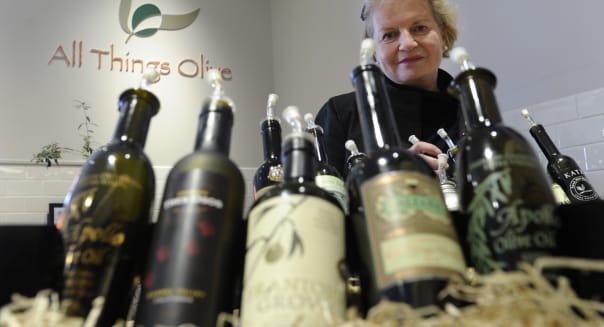 Susan Walsh/APCalifornia Olive Oil Council Executive Director Patricia Darragh. WASHINGTON -- It's a pressing matter for the tiny U.S. olive oil industry: American shoppers more often are going for European imports, which are cheaper and viewed as more authentic. And that's pitting U.S. producers against importers of the European oil, with some likening the battle to the California wine industry's struggles to gain acceptance decades ago. The tiny California olive industry says European olive oil filling U.S. shelves often is mislabeled and lower-grade oil, and they're pushing the federal government to give more scrutiny to imported varieties. One congressman-farmer even goes so far as suggesting labels on imported oil say "extra rancid" rather than "extra virgin." Imposing stricter standards might help American producers grab more market share from the Europeans, who produce in bulk and now have 97 percent of the U.S. market. Olive oil production is growing steadily. The domestic industry, with mostly high-end specialty brands, has gone from 1 percent of the national olive oil market five years ago to 3 percent today. Most of the production is in California, although there are smaller operations in Texas, Georgia and a few other states. Seeking to build on that, the domestic industry has mounted an aggressive push in Washington, holding olive oil tastings for members of Congress and lobbying them to put stricter standards on imports. The strategy almost worked last year when industry-proposed language became part of a massive farm bill passed out of the House Agriculture Committee. The provision backed by California lawmakers would have allowed the Agriculture Department to extend mandatory quality controls for the domestic industry to imports. The bill's language would have allowed government testing of domestic and imported olive oil to ensure that it was labeled correctly. That testing, intended to prevent labeling lower-grade olive oil as "extra virgin" or fraudulently cutting in other types of oil, would be much more comprehensive than what imported oils are subjected to now. But the language was stripped from the bill when it reached the House floor, an effort led by lawmakers from New York, where many of the country's olive oil importers are based. They had the backing of food companies and grocery stores that use and sell olive oil. The floor fight broke down to one between East Coast and West Coast lawmakers. Republican Rep. Doug LaMalfa, a farmer from Northern California, suggested that labels for imported oil should say "extra rancid." "What we're after here is not to cause problems for our friends who would like to market it. It's more just the truth in advertising that's necessary," LaMalfa said. New York Republicans said new testing standards would cost importers millions of dollars. Republican Rep. Michael Grimm of Staten Island, N.Y., said his Greek-American and Italian-American constituents know good oil and haven't had problems. "It's not rancid," he said. "There is always going to be a problem in every industry, but this is nothing more than a multimillion-dollar earmark," he added, using the term for special provisions that sometimes are inserted into legislation. In the end, the final farm bill signed by President Barack Obama earlier this month was silent on olive oil. But a nonbinding statement accompanying the bill encouraged the Agriculture Department, the U.S. Trade Representative and the Food and Drug Administration to "remove the obstacles that are preventing the U.S. olive oil industry from reaching its potential." It cited a 2013 U.S. International Trade Commission report that said international standards are widely unenforced and allow many varieties to be mislabeled and possibly even adulterated. The report also cited subsidies for European olive oil producers and tariffs as barriers to the domestic industry's success. The California olive oil industry widely promoted that report and even boasted of helping to influence it. According to the American Olive Oil Producers Association, California producers arranged farm tours for federal investigators, arranged for witnesses to testify to the group, and even held an olive-oil tasting on Capitol Hill for lawmakers and administration officials. For now, the domestic industry says it will keep pushing. Kimberly Houlding, executive director of the American Olive Oil Producers Association, says producers are still considering petitioning the USDA for an order to establish mandatory quality standards, including frequent testing. Ideally the order would apply to the entire domestic industry, including importers, Houlding says. Eryn Balch of the North American Olive Oil Association, which represents the importers, says they would like to work with the domestic industry to grow the olive oil market in the United States. There's still a lot of the market to grab -- only around 40 percent of U.S. consumers use olive oil right now, and olive oil has only about 15 percent of the volume share compared with other cooking oils. But that market is growing along with increased awareness of olive oil's health benefits compared with other oils. Extra virgin olive oil is often rich in polyphenols, nutrients that are thought to be helpful in preventing heart disease and other illnesses. "If the industry promoted the key proven benefits with a common voice and positive message, the growth potential could be almost limitless," Balch said. The United States now consumes the third largest amount of olive oil of any nation, behind Italy and Spain, according to the trade commission report. The report said consumption has risen by more than 50 percent since 2001 but said most U.S. consumers aren't able to distinguish good olive oil from bad, so they gravitate toward the least costly. Patricia Darragh, director of the California Olive Oil Council, says the domestic industry wouldn't have the capacity to supply all of the country's olive oil, but it is a grassroots industry that is continuing to grow. And in another decade or two, Americans may be more familiar with the domestic variety. "We're where the California wine industry was 20 or 30 years ago," Darragh says. Pre-made soups can contain a large number of ingredients containing GMOs. For instance, Campbell's (CPB) popular condensed Tomato Soup lists high fructose corn syrup as its second biggest ingredient. According to the Non-GMO Project, nearly 88 percent of all corn planted in the United States is GMO.

 Subscribe via Email
  Subscribe RSS Comments Please leave your comment:
 38.01 (1y: -5%) $(function() { var seriesOptions = [], yAxisOptions = [], name = 'UL', display = ''; Highcharts.setOptions({ global: { useUTC: true } }); var d = new Date(); $current_day = d.getDay(); if ($current_day == 5 || $current_day == 0 || $current_day == 6){ day = 4; } else{ day = 7; } seriesOptions[0] = { id : name, animation:false, color: '#4572A7', lineWidth: 1, name : name.toUpperCase() + ' stock price', threshold : null, data : [[1359957600000,40.19],[1360044000000,40.62],[1360130400000,39.91],[1360216800000,39.57],[1360303200000,39.65],[1360562400000,39.52],[1360648800000,39.76],[1360735200000,39.57],[1360821600000,40.14],[1360908000000,39.79],[1361253600000,40.39],[1361340000000,40.4],[1361426400000,39.91],[1361512800000,40.23],[1361772000000,39.27],[1361858400000,39.07],[1361944800000,39.75],[1362031200000,39.85],[1362117600000,40.05],[1362376800000,40.32],[1362463200000,40.57],[1362549600000,40.38],[1362636000000,40.77],[1362722400000,40.89],[1362978000000,40.95],[1363064400000,40.9],[1363150800000,40.94],[1363237200000,41.35],[1363323600000,41.2],[1363582800000,41.24],[1363669200000,41.53],[1363755600000,41.73],[1363842000000,41.41],[1363928400000,42.03],[1364187600000,41.88],[1364274000000,41.79],[1364360400000,41.55],[1364446800000,42.24],[1364792400000,42.2],[1364878800000,42.61],[1364965200000,42.55],[136505160